Higher Education SEO in the UAE: Recruit via Search
Last updated · 12 min read
Key takeaways
- Students search for a program, a city and a constraint such as fees or recognition. Each accredited program needs its own page that answers that search.
- Since 1 January 2026, UAE federal law prohibits offering, promoting or advertising a program before it holds Program Accreditation. A “coming soon” program page can count as promotion.
- Google retired the Course Info rich result in 2025. Course list markup still works, but only in English and only for three or more courses.
- Google Search Console now reports impressions in AI Overviews and AI Mode by country, which maps to your recruitment markets.
Higher education SEO in the UAE (United Arab Emirates) is the work of getting each accredited program page found on Google and named in AI answers when students compare programs, then turning that visit into an inquiry. The program page does the recruiting, not the homepage.
Two things changed the job in 2026. A federal law now bars universities from promoting a program before it is accredited. And Google retired the course markup many university sites still rely on, while AI answers keep recommending it.
What is higher education SEO in the UAE, and why does it matter in 2026?
Higher education SEO in the UAE matters more in 2026 because more universities now compete for the same students in the same searches. A student comparing MBA programs in Dubai sees portals, agents, branch campuses and federal universities on one results page. The institution with the clearest program page usually gets the inquiry.
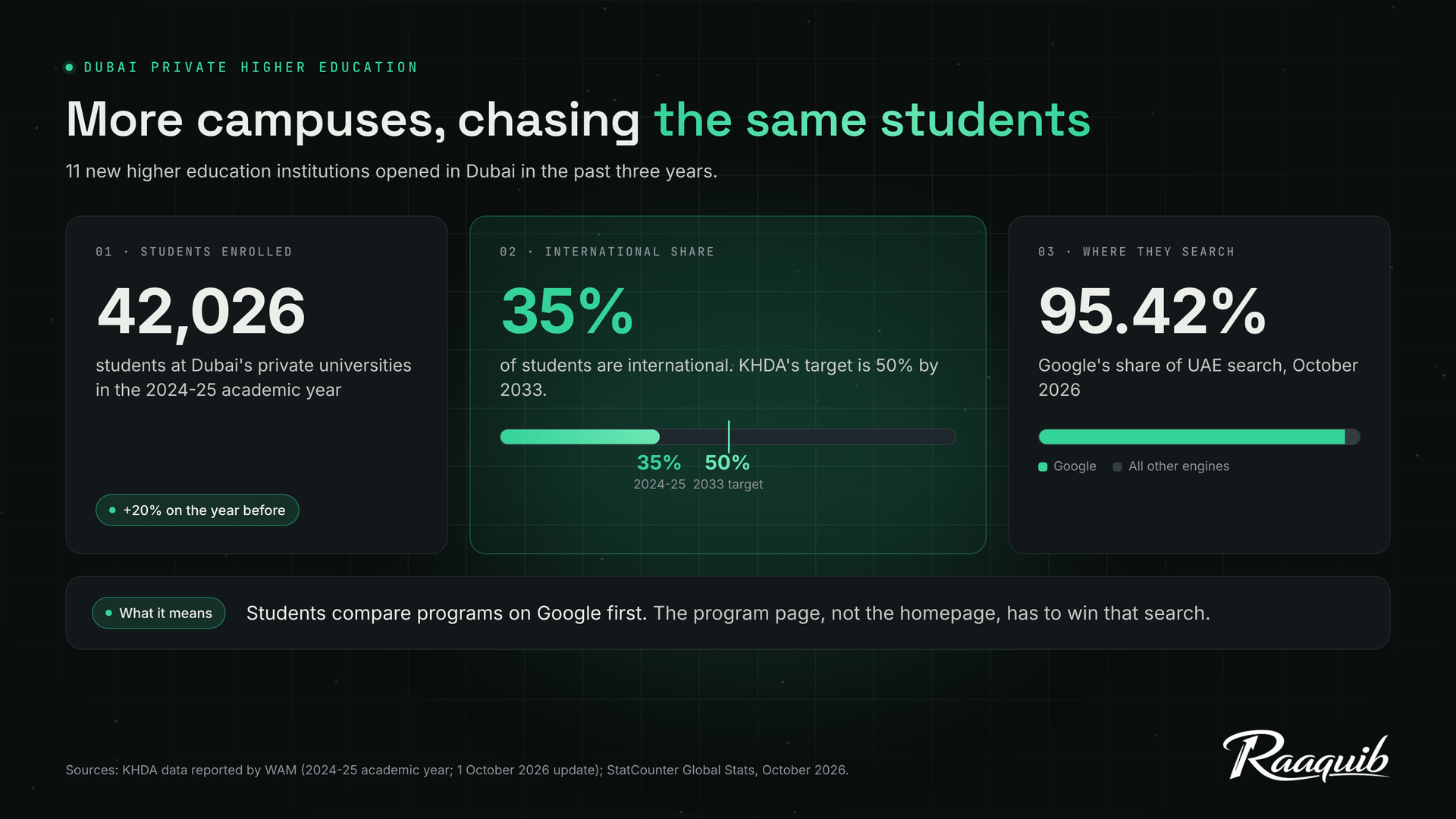
According to Knowledge and Human Development Authority (KHDA) data reported by the Emirates News Agency (WAM), Dubai's private universities enrolled 42,026 students in the 2024-25 academic year. Enrollment rose 20% on the year before. International students made up 35% of the 2024-25 total, and KHDA's target is 50% by 2033.
According to KHDA's 1 October 2026 update, 11 new higher education institutions opened in Dubai over the past three years. The American University of Beirut opened its Dubai campus in September 2026.
In the UAE, search means Google. Google held 95.42% of UAE search engine market share in October 2026, according to StatCounter. My UAE search behavior data covers devices and languages.
How do prospective students search for a university program?
Students search for a program, a place and a constraint. They type “MBA in Dubai”, “computer science fees UAE” or “is this degree accredited in the UAE”. University SEO wins when the program page answers that exact search, because the student has already decided what to study and is now choosing where.
| Search type | Example search | What the student wants | Page that should rank |
|---|---|---|---|
| Program plus city | MBA in Dubai | A shortlist | Program page |
| Program plus fees | data science master's fees UAE | A price to compare | Program page, fees section |
| Recognition check | is [program] accredited in UAE | Proof the degree counts | Program page, accreditation line |
| Scholarship | engineering scholarship Dubai | A way to afford it | Scholarships page linked to programs |
| Brand plus admissions | [university] admission requirements | Next steps | Admissions page linked to programs |
Examples are illustrative. They are not measured search volumes.
On 2 November 2026, Google's People Also Ask box on my UAE recruitment search showed “Which universities are approved by the UAE?” Students check recognition early. Your program page should answer that question before they leave to check elsewhere.
Student recruitment marketing and SEO share one asset for this reason. Paid campaigns, agents and AI answers all send students to the program page. The program page has to answer the question that brought them, in the words they used.
What should a program page include to rank and convert?
A program page ranks and converts when it states, in plain text, the facts a student checks before applying. Those facts are the award, duration, intakes, fees in AED, entry requirements and accreditation status. Each accredited program needs its own indexable page. A single “all programs” list cannot rank for “MBA in Dubai”.
| Element | What to show | Why it matters |
|---|---|---|
| Title and H1 | Program name, level and city | Matches how students search |
| Accreditation line | Licensing body, accreditation status, link to the official record | Students and AI answers check it |
| Fees | Tuition in AED and other mandatory fees | The most common comparison |
| Intakes | Next start dates and application deadline | Decision windows are short |
| Entry requirements | Grades and English test scores | Filters applicants before they inquire |
| Outcomes | Careers, internships, professional body recognition | The reason to choose you |
| Inquiry path | Apply, brochure, talk to admissions | Turns the visit into a lead |
This checklist reflects my program page SEO work, not a Google requirement.
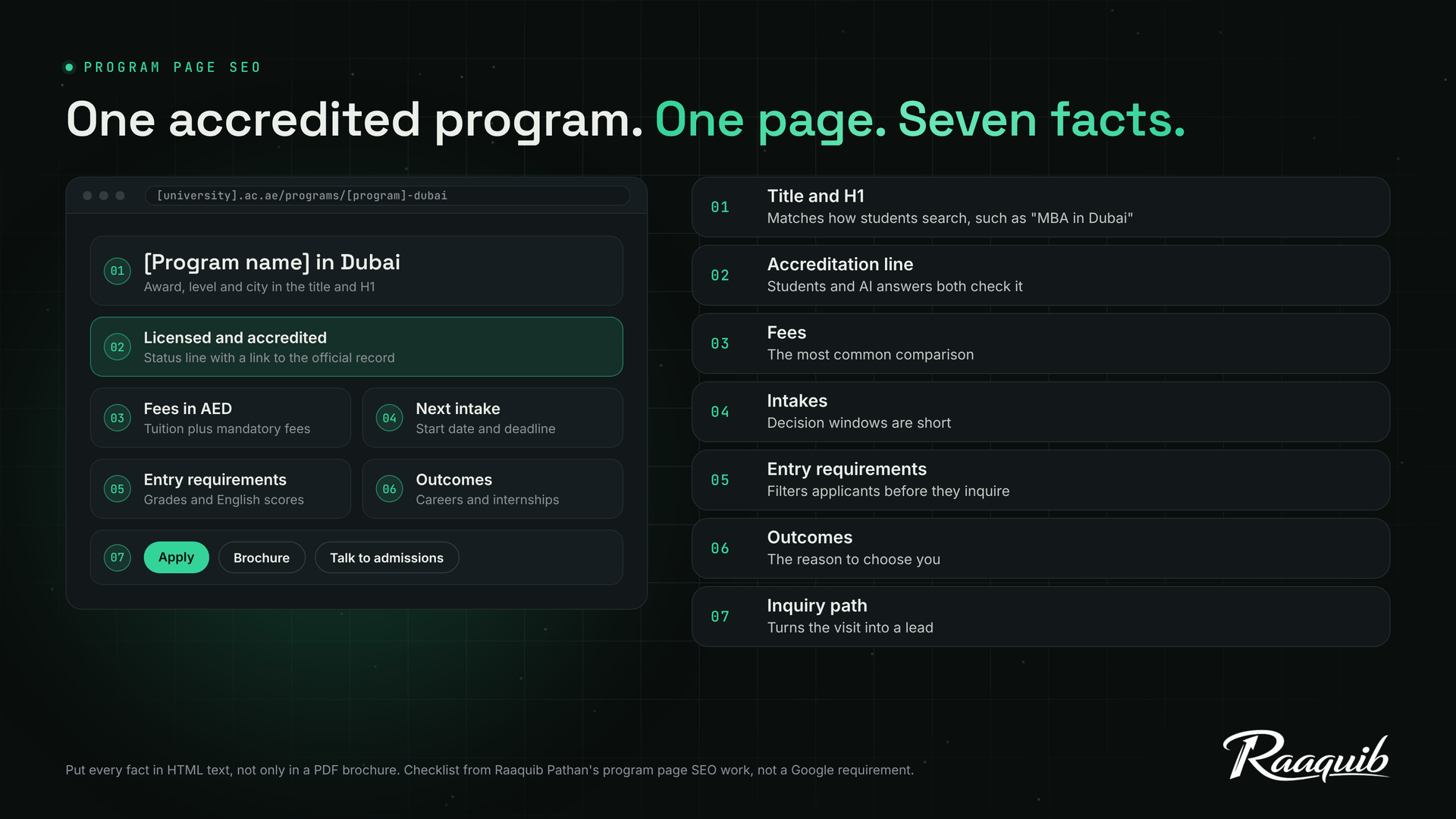
Put these facts in HTML text, not only in a PDF brochure or an image. Google's AI features documentation says a page must be indexed and eligible to be shown with a snippet to appear in AI Overviews or AI Mode. A fee hidden inside a PDF is easy for a student to miss and harder for an AI answer to quote.
If you recruit Arabic-speaking students, build real Arabic program pages, not machine translations. Hreflang tags are code that tells Google which pages are language versions of each other. Google's localization guidance says each language version must list itself and all other versions in those tags. My guide to bilingual SEO in the UAE covers the setup.
Then link every guide to its program. A post on “MBA or MSc in management” should link to both program pages, and each program page should link to its fees, scholarships and admissions pages. I used this pattern in English and Arabic in my UAE online university case study.
A new branch campus starts with no search history in its city, so I begin with the program pages. For a UK university's new Dubai campus, I rewrote each program page around the words students search, linked a detailed guide to each program, and earned links from education sites. Organic traffic rose 320% and organic leads from Google rose 140%, checked in Google Analytics 4 (GA4).
The UK university Dubai campus case study does not state the project length, so read it as proof of the method.
What can a university publish before a program is accredited?
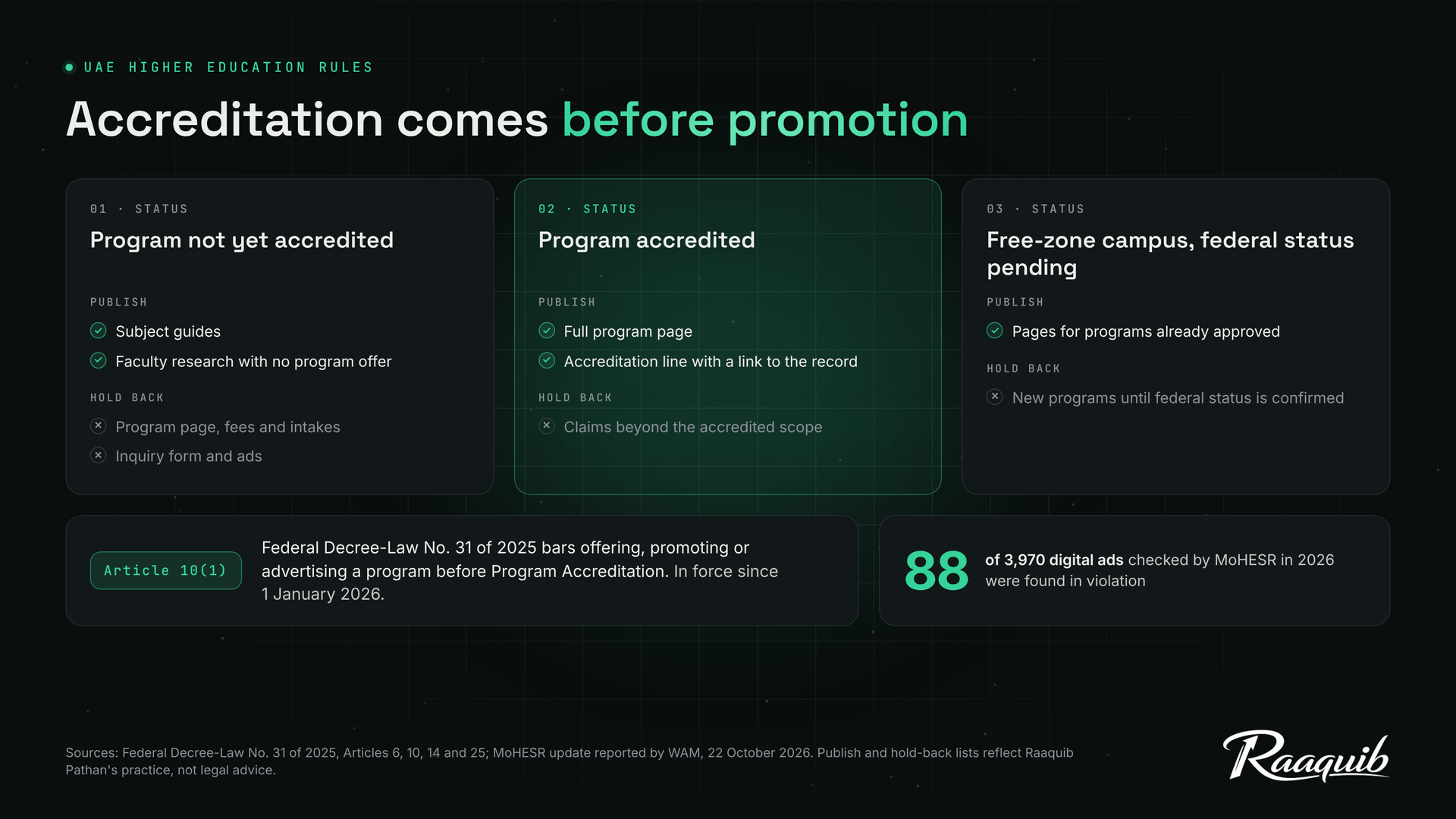
Under UAE federal law, nothing that promotes the program. Federal Decree-Law No. 31 of 2025 has been in force since 1 January 2026. It prohibits a higher education institution from offering, promoting or advertising any academic program, or admitting students, before Program Accreditation.
The ban sits in Article 10(1) of Federal Decree-Law No. 31 of 2025, published as a PDF by the Ministry of Higher Education and Scientific Research (MoHESR). Article 6(1) also bars promoting programs before the institution holds Institutional Licensure.
Free-zone campuses are covered. Article 14 requires them to obtain a Local Permit from the local authority, which is KHDA in Dubai, and then federal Institutional Licensure. Article 25 gives existing institutions one year from 1 January 2026 to rectify their status.
The Commission for Academic Accreditation (CAA) says institutions must receive program accreditation before recruiting students or enrolling them. KHDA's guidance for free-zone providers, last updated in 2022, says they need written KHDA approval before using any advertising material.
The rule is enforced. MoHESR monitored 3,970 digital advertisements in 2026 and found 88 in violation, according to its 22 October 2026 update reported by WAM. Ibrahim Fikri, Acting Assistant Under-Secretary at MoHESR, said in May 2026 that AI tools enable “faster, more accurate monitoring of advertising content”.
| Program status | What I would publish | What I would hold back |
|---|---|---|
| Not yet accredited | Subject guides and faculty research with no program offer | Program page, fees, intakes, inquiry form, ads |
| Accredited | Full program page with the accreditation line | Claims beyond the accredited scope |
| Free-zone campus, federal status pending | Pages for programs already approved | New programs until federal status is confirmed |
Sources: Decree-Law No. 31 of 2025, Articles 6, 10, 14 and 25; CAA; KHDA. The two right columns are my practice, not legal advice.
Which schema markup still helps university sites in 2026?
Less than most university sites assume. Google retired the Course Info rich result in 2025 and stopped showing the FAQ rich result in 2026. The Course list carousel still exists, but only in English and only for pages that mark up at least three courses.
Google phased out Course Info along with six other structured data types in June 2025. “This update won't affect how pages are ranked,” wrote Henry Hsu, Product Manager at Google Search. Google removed Course Info from Search Console reports on 9 September 2025.
Google's course list documentation says the rich result is available in English and that you must mark up at least three courses, with Carousel markup on a summary page. Your Arabic program pages cannot earn it. Google also removed its FAQ rich result documentation in June 2026 because the feature no longer shows in results.
The AI answers I tested still recommend the old markup.
| Where I tested | What the AI said | What Google's documentation says |
|---|---|---|
| Google AI Mode | Add Course schema “to capture rich snippets” | Course Info retired in 2025; Course list is English only |
| ChatGPT, logged out | Add Course and EducationalOccupationalProgram | EducationalOccupationalProgram is not a Google Search feature; Course list is English only |
Source: my tests with UAE settings, 2 November 2026, and Google's documentation.
For AI features, Google says there is no special schema.org structured data you need to add to appear in AI Overviews or AI Mode. Use markup to describe facts already visible on the page, and spend the saved time on the facts themselves.
How do universities get cited in Google AI Mode and ChatGPT?
Universities get cited when their pages are crawlable, indexed and state specific facts that other sources do not. Google says optimizing for its AI features is still SEO, which I unpack in SEO vs GEO. ChatGPT can show your pages in its search answers only if OpenAI's search crawler is allowed to reach them.
Answer Engine Optimization (AEO) structures a page so an AI answer can lift it. Generative Engine Optimization (GEO) shapes content and authority so AI tools name your brand. Google's 2026 guide says that, from Google's view, optimizing for generative AI search is still SEO. The same guide rewards non-commodity content, meaning facts and experience that a summary of other pages cannot copy.
Two settings decide whether you are eligible at all. Google says you can manage inclusion through the Search generative AI control in Search Console. OpenAI says sites opted out of OAI-SearchBot will not be shown in ChatGPT search answers.
Be careful with country pages. ChatGPT's answer to my test prompt proposed pages such as /students-from-india/ and /students-from-pakistan/. Google's spam policies list pages targeted at specific regions or cities that funnel users to one page as doorway abuse. Keep a country page only if visa steps, documents, recognition or fees genuinely differ.
| Surface tested | What it got right | What it got wrong or missed |
|---|---|---|
| Google AI Overviews (6 searches) | Nothing to assess | No AI Overview appeared |
| Google AI Mode (1 prompt) | Program pages, fees in AED, hreflang | Named “Ministry of Education UAE or KHDA” as licensing bodies; recommended Course for rich snippets |
| ChatGPT, logged out (1 prompt) | No special schema needed; OAI-SearchBot; MoHESR and CAA | Country page set; no mention of the advertising ban |
Source: my tests with UAE settings, 2 November 2026.
Neither AI answer mentioned that the law bars promoting unaccredited programs. State your licensure and accreditation on every program page in one plain line, so the AI answer does not have to guess.
How do you measure student recruitment from search?
Measure inquiries and enrollments by program in your admissions customer relationship management (CRM) system, then trace each one back to the search that started it. Search Console now reports AI Overviews and AI Mode impressions, and ChatGPT tags its referrals.
| Source | What it shows | Where it goes |
|---|---|---|
| Search Console Generative AI report | Impressions in AI Overviews and AI Mode by page, country and device | AI visibility per program and market |
| GA4 with utm_source=chatgpt.com | Visits from ChatGPT search | Inquiries by source |
| Admissions CRM | Applications, offers and enrollments | Joins search to enrolled students |
Google rolled out its Generative AI performance reports to all websites on 31 August 2026. The reports show impressions, not clicks. The country split is the useful part for admissions, because it maps to your recruitment markets.
OpenAI says ChatGPT adds utm_source=chatgpt.com to referral URLs. Pass that source from GA4 into your CRM with each inquiry, so reports count students, not sessions.
Most university sites I audit share three gaps. Program pages bury fees and intakes. Accreditation appears nowhere a student or an AI answer can find it. And nothing connects a search visit to an enrolled student.
As a university SEO consultant in Dubai, I rebuild program pages around how students search and check every page against your licensure and accreditation status. Then I connect Search Console and GA4 to your admissions CRM.
Frequently asked questions
Can a UAE university publish a page for a program that is not yet accredited?
Not one that promotes the program, because Article 10(1) of Federal Decree-Law No. 31 of 2025 prohibits offering, promoting or advertising any academic program, or admitting students, before Program Accreditation. Subject guides and faculty research that make no program offer are a safer choice, but confirm each page with your compliance team.
Does Course schema still give university pages rich results?
Only in a narrow case, because Google retired the Course Info rich result in 2025. The Course list carousel remains for English pages that mark up at least three courses with Carousel markup, so Arabic program pages cannot earn it.
Do UAE universities need Arabic program pages?
Yes, if Arabic-speaking students are part of your intake, build a real Arabic version of each program page with the same fees, intakes and accreditation line as the English page. Connect the two versions with hreflang tags so Google can show each student the right language.
How can a university track its visibility in Google AI Overviews?
Use the Generative AI performance report in Google Search Console, which Google rolled out to all websites on 31 August 2026. It shows AI Overviews and AI Mode impressions by page, country and device, so pair it with ChatGPT referrals in GA4 and your admissions CRM data.
Raaquib Pathan
SEO and AI Search Consultant, Dubai
Raaquib Pathan is an SEO and AI search consultant based in Dubai. He has worked in search since 2019 across agency, in-house SaaS and independent consulting, helping brands grow organic traffic and get cited inside AI answers.
Want your brand cited in AI answers?
Book a free strategy call. We look at where you show up across Google and AI search today, and the fastest path to being the source that gets cited.
University SEO Consultant in Dubai
Program pages rebuilt around how students search, checked against licensure and accreditation.
Read moreConsultingBilingual SEO in the UAE
How Google reads Arabic and English pages, hreflang, and the URL structure to pick.
Read moreAI SearchSEO vs GEO
What actually differs, what Google's documentation says, and how to measure AI visibility.
Read more