
AI SEO Case Study: Ranking a New SaaS Inside AI Answers
How I took a brand-new German SaaS platform from zero authority to 100K GenAI impressions, and citations inside AI answers, in three months.
- Vertical
- B2B SaaS
- Market
- Germany / EU
- Timeline
- 3 months
- Services
- AEO, GEO, Technical SEO
What does this AI SEO case study show?
It shows a new SaaS site winning AI search visibility fast, using AEO and GEO instead of years of domain authority.
A German SaaS platform in the European funding space launched with zero authority. No backlinks. No history. No presence inside AI answers.
In three months of AEO (Answer Engine Optimization, getting cited inside AI answers, not just ranked in blue links) and GEO (Generative Engine Optimization, shaping how AI engines describe your brand), it changed fast.
It reached 2,000+ organic clicks a month, crossed 100K GenAI impressions in Google Search Console, and began earning citations inside AI answers.
What were the results in three months?
Five outcomes, every number pulled straight from Google Search Console or GA4.
2,000+
Organic clicks per month
Reached within the first three months, measured in Google Search Console.
100K
GenAI impressions in GSC
Logged in the new Search Console Generative AI features report, inside three months.
200+
Referral visits from LLMs
Sessions from ChatGPT and other major AI assistants, tracked in GA4.
50+
Signups per month
New product signups per month after the first quarter of work.
EU .gov
Natural government links
Editorial links earned from European government domains, entirely unpaid.
Sources: Google Search Console and Google Analytics 4. Nothing modelled or estimated.
TL;DR, key takeaways
- A brand-new German SaaS site went from zero authority to 2,000+ organic clicks a month in three months.
- The engine was AEO and GEO: formatting content so AI answers cite it, not just so Google ranks it.
- GenAI impressions in Search Console crossed 100K, our clearest proxy for AI search visibility.
- ChatGPT and other LLMs sent 200+ referral visits, and signups settled above 50 a month.
- Every number here comes from Google Search Console or GA4. Nothing is estimated or modelled.
What was the challenge?
A new brand with no authority, trying to win informational queries against entrenched incumbents.
Zero domain authority
The site launched brand new. No backlinks, no history, no trust signals. That is the hardest possible starting line for both classic search and AI answers.
A crowded funding niche
The goal was to own the European funding space. That means grants, subsidies and public programmes, topics where established players already sit at the top.
Invisible inside AI answers
Product-market fit was strong, but the brand appeared nowhere in ChatGPT, Gemini or AI Overviews. As answers absorb clicks, that gap costs real pipeline.
The toughest part: EU government and public-sector domains own many funding queries. Competing for those informational searches means out-formatting sites that carry huge inherent trust, so being the clearest, most quotable answer mattered more than raw authority.
How do you rank a new SaaS inside AI answers with zero authority?
You make the brand the easiest, most trustworthy thing for an AI model to quote, then earn signals everywhere that model already looks.
Eight pillars ran in parallel, grouped into three fronts. Expand any pillar for the detail and why it works for AI search. As a startup AI SEO play, it stayed lean and fast.
On-site foundation
Everything we controlled directly on the domain, built to be quoted.
Country-specific pages written to be cited
We built pages for each target market, structured around clear questions and self-contained answers. Short paragraphs, direct definitions, and clean formatting an AI model can lift in one pass.
Why for AIAtomic, quotable sentences are what language models pull into an answer.
LLM info page and an llms.txt file
We published a plain-language file describing the product, who it serves and how to describe it. It gives AI assistants a canonical, unambiguous source for the brand.
Why for AIA consistent entity description reduces the chance a model guesses or invents details.
A dedicated FAQ page
We answered the real questions buyers ask about the product, one question per block. Each answer stands alone, so it reads as a complete fact without the page around it.
Why for AIQuestion-and-answer blocks map directly onto how AI engines retrieve and cite content.
Regular, human-reviewed blog publishing
We shipped a steady cadence of genuinely useful posts on the site itself. Every piece was reviewed by a human for accuracy before it went live. Quality over volume.
Why for AIFreshness plus factual accuracy keeps a source trustworthy enough for models to reuse.
Off-site and parasite
Borrowing reach and trust from platforms that already had it.
Parasite SEO through best-tool listicles
We earned placements in “X best tools” roundups on high-authority sites. Ranking on a domain that already has trust is far faster than building that trust from scratch.
Why for AIAI answers lean heavily on listicles when recommending tools in a category.
Community answers on Reddit and Quora
We joined real, country-specific threads where buyers asked for help, and gave genuinely useful replies. No spam, just relevant context that happened to mention the product.
Why for AIModels are trained on and cite community platforms when summarising opinions.
Supporting posts on LinkedIn
We reinforced the same positioning on LinkedIn to build recognition with the professional audience. It compounds brand searches, which are themselves a trust signal.
Why for AIConsistent messaging across platforms strengthens the entity a model associates with the brand.
Authority and PR
The slow-burn work that earns real editorial trust.
Digital PR for mid-tier EU news links
We ran outreach that earned editorial links from mid-tier European news sites. Real journalists, real stories, the kind of coverage that builds durable authority.
Why for AICitations from recognised news domains raise how much weight a model gives the source.
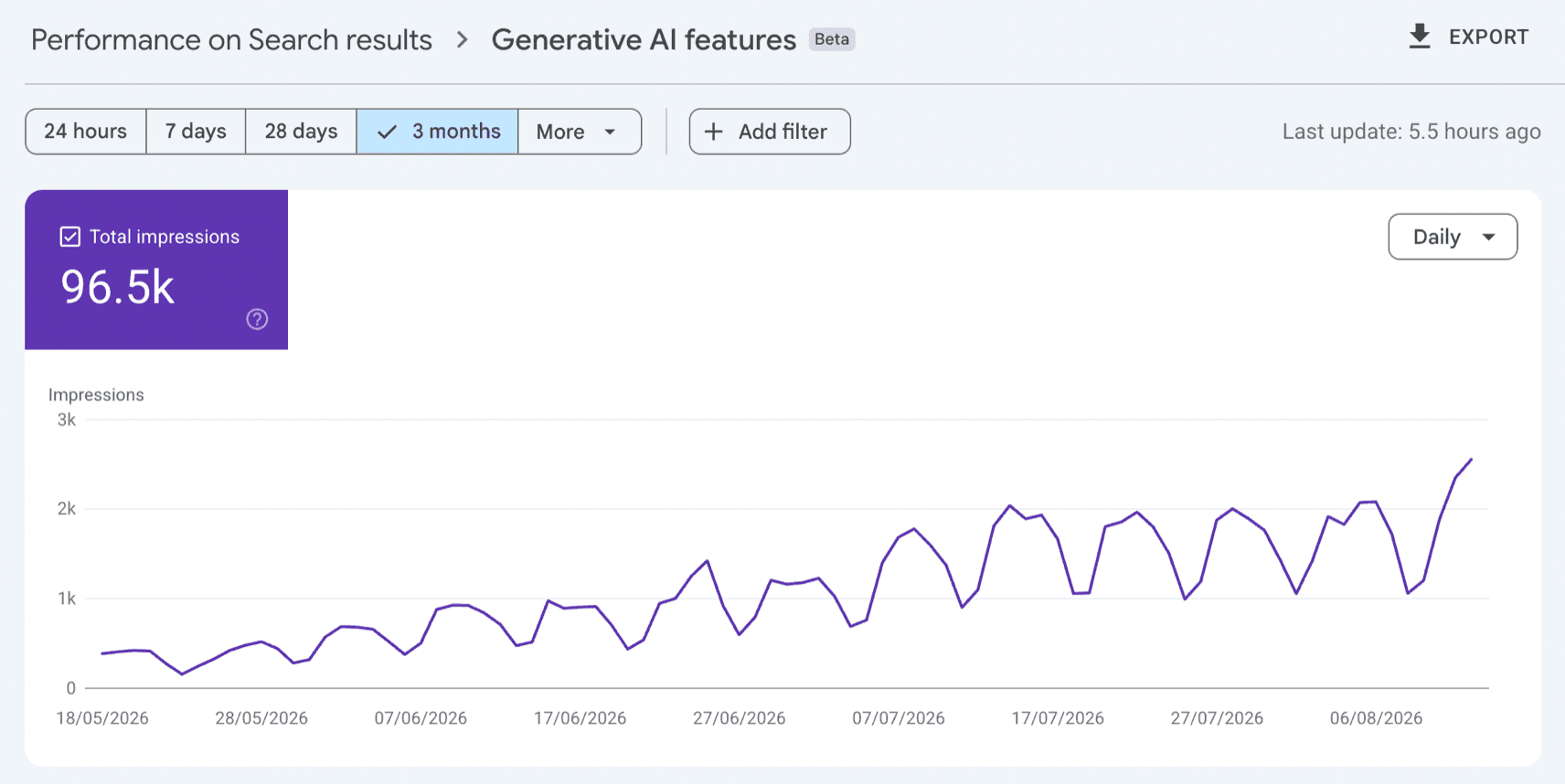
What does the GenAI data show?
A steady climb in how often the brand appeared inside Google's AI features over the three-month window.
GenAI impressions count how often the site surfaced inside Google's generative AI features. It is the closest official signal we have for AI search reach, so a rising curve here is the clearest proxy for the work landing.
What did each result actually mean?
Numbers only matter with context. Here is what each one represents and where it came from.
- 2,000+Organic clicks per month
- Reached within the first three months, measured in Google Search Console.
- 100KGenAI impressions in GSC
- Logged in the new Search Console Generative AI features report, inside three months.
- 200+Referral visits from LLMs
- Sessions from ChatGPT and other major AI assistants, tracked in GA4.
- 50+Signups per month
- New product signups per month after the first quarter of work.
- EU .govNatural government links
- Editorial links earned from European government domains, entirely unpaid.
Want results like these? See more verified SEO case studies, or read how I approach Answer Engine Optimization for brands in Germany.
What I'd tell you honestly
AEO and GEO are still young. Much of this was tested in parallel, not assumed to work.
Many tactics ran at the same time. So I can point to what moved together, but I cannot always isolate the single cause of a single win.
No tool today can measure how often a brand is cited inside AI answers, or on which prompt. That data simply is not exposed yet.
So I lean on proxies I can verify: LLM referral traffic in GA4, and the new GenAI report in Search Console. They are the closest honest signals available.
Methodology & data sources
- Organic clicks and GenAI impressions: Google Search Console.
- LLM referral visits and signups: Google Analytics 4.
- Window: the first three months of work. Client kept anonymous by request.
AI SEO case study, questions answered
Real questions people ask about AEO, GEO and measuring AI search results.
What is an AI SEO case study?
An AI SEO case study documents how a website grew its visibility inside AI search, not just blue links. This one tracks a new SaaS site earning AI citations, organic clicks and LLM referrals, all verified in GSC and GA4.
How long does AEO take to show results?
AEO (Answer Engine Optimization) can show early movement within a few months. This project reached over 2,000 organic clicks a month in three. Speed depends on your niche, how citation-friendly your content is, and how often you publish.
Can you track LLM citations?
Not directly. No tool today can tell you how often a brand is cited inside AI answers, or on which prompt. The closest proxies are LLM referral traffic in GA4 and the Generative AI features report in Google Search Console.
Does AEO work for a brand new domain?
Yes. This case study started with zero domain authority and no backlinks. AEO does not need an aged domain to begin working, because AI answers pull from clearly formatted, trustworthy sources. Earning links in parallel still helps, and we did.
What is the difference between AEO and GEO?
AEO (Answer Engine Optimization) is about getting cited inside direct AI answers, like ChatGPT replies or AI Overviews. GEO (Generative Engine Optimization) shapes how generative engines understand your brand. They overlap heavily and usually run together, as they did here.
How do you measure results from AI search?
We rely only on official sources. Organic clicks and GenAI impressions come from Google Search Console. Referral visits from ChatGPT and other assistants come from GA4. We treat these as proxies, because no platform reports exact citation counts yet.
Want your SaaS cited inside AI answers?
Book a free strategy call. We'll look at where you show up across Google and AI search today, and map the fastest path to being the source that gets cited.