
Ecommerce SEO UAE: Compete With Amazon.ae and Noon
Last updated · 12 min read
Key takeaways
- Amazon.ae and noon usually win broad product searches. Focused UAE stores can win category, attribute and buying-guide searches.
- Google says filter pages waste crawling, and recommends blocking the ones you don't need indexed.
- Google asks for a separate web address (URL) per currency, so one page that switches between UAE dirhams (AED) and Saudi riyals (SAR) is a problem.
- Google says AI Overviews and AI Mode need no special optimization. Accurate, matching product data matters more.
Ecommerce search engine optimization (SEO) in the UAE is the work of getting an online store's category and product pages found by shoppers in the United Arab Emirates. That means ranking on Google and being named in artificial intelligence (AI) shopping answers. For most independent stores, ecommerce SEO UAE work means competing for the same results page as Amazon.ae and noon. You won't beat them on range, but you can beat them on focus and clean product data.
Can a UAE online store outrank Amazon.ae and noon?
A UAE online store can outrank Amazon.ae and noon on some searches, but rarely on broad product names. Marketplaces win generic terms through range and authority. Independent stores win when the search needs guidance, a specific attribute or local delivery detail.
The scale gap is real. When Amazon.ae replaced Souq in the UAE on 1 May 2019, Amazon said the site launched with over 30 million products, including five million from Amazon US.
The search channel still matters for stores of every size. StatCounter recorded Google at 93.47% of UAE search engine market share in September 2026. In a March 2025 survey of 1,110 online UAE adults, commissioned by Google and run by Public First, 94% said they use Google Search at least monthly to compare prices.
UAE shoppers compare on Google before they buy, so the question is not whether to compete with the marketplaces, but where. My UAE search behavior data covers device and language use in more depth.
Where do independent stores win against marketplaces?
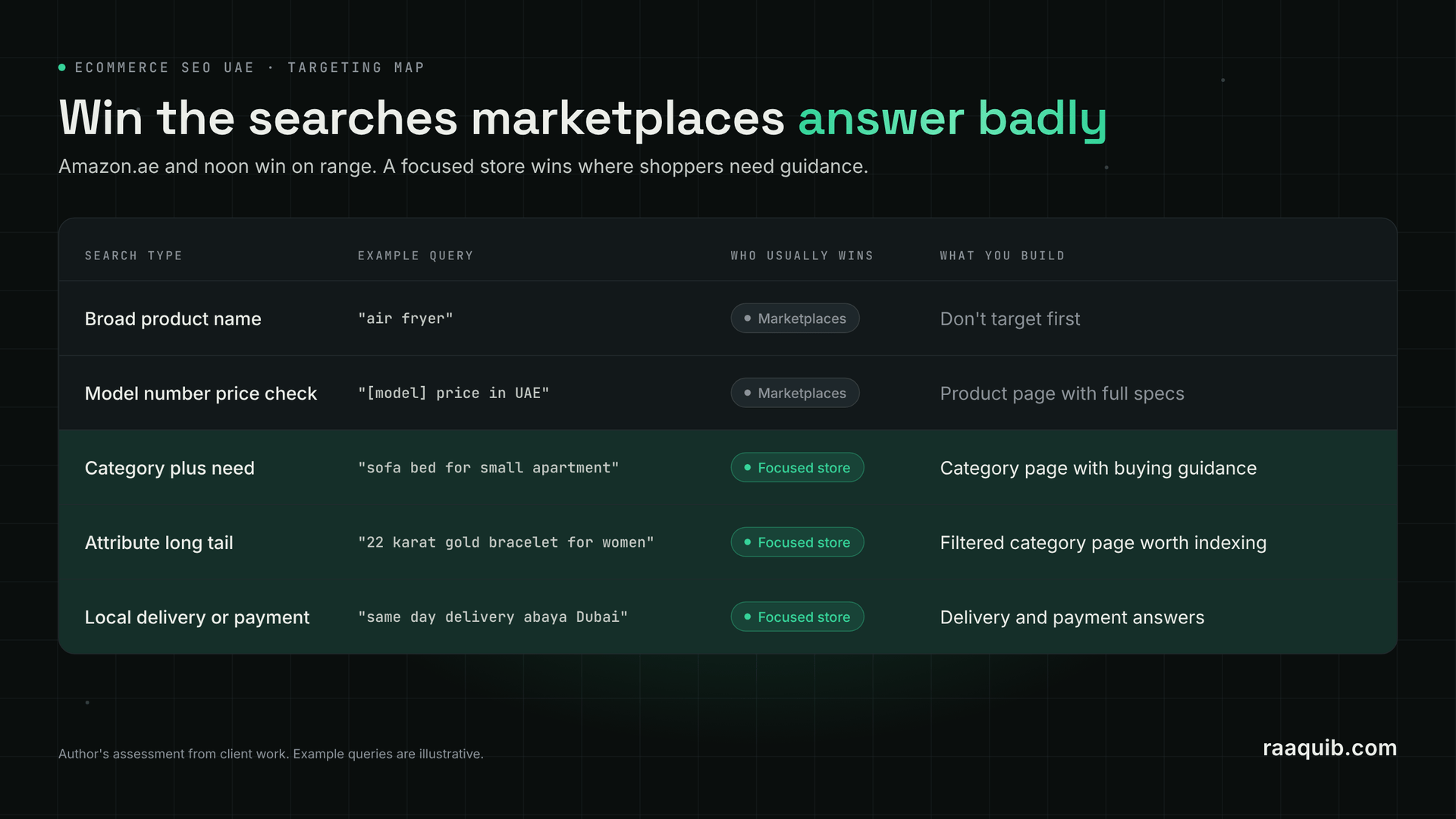
Independent stores win where a marketplace listing gives a thin answer. That covers category searches with a buying question, attribute searches such as material or size, and UAE delivery or payment questions. Broad product names and model-number price checks usually go to Amazon.ae and noon.
| Query type | Example | Who usually wins | What you build |
|---|---|---|---|
| Broad product name | “air fryer” | Marketplaces | Don't target first |
| Model number price check | “[model] price in UAE” | Marketplaces | Product page with full specs |
| Category plus need | “sofa bed for small apartment” | Focused store | Category page with buying guidance |
| Attribute long tail | “22 karat gold bracelet for women” | Focused store | Filtered category page worth indexing |
| Local delivery or payment | “same day delivery abaya Dubai” | Focused store | Delivery and payment answers on category pages |
Author's assessment from client work. Example queries are illustrative, not measured volumes.
Category page optimization: build the page a marketplace can't
Category page optimization means turning a product grid into a landing page that answers the shopper's real question. A marketplace lists thousands of items. Your page can explain which product suits which need and show delivery and return terms.
Google treats your internal links as a map of what matters. Google's ecommerce documentation says it can use the number of links to a page and the clicks needed to reach it to judge that page's relative importance. Link your menus to categories, categories to subcategories, and subcategories to every product you want indexed.
One detail catches many stores. Google says Googlebot, its crawler, generally doesn't type into search boxes. A product reachable only through your site search may never be found by crawling.
A strong UAE category page usually has:
- A two or three sentence introduction that answers the main buying question
- Delivery times, return terms and payment options such as cash on delivery, in plain text
- Links to the most useful subcategories and best sellers
- A short buying guide or frequently asked questions (FAQ) block below the grid, from your own product knowledge
Pagination needs care on large categories. Google's guidance is to link each page to the next with standard links and give each page its own URL. Don't use the first page as the canonical for the whole series. A canonical tag is the line of code that tells Google which version of a page is the main one.
How should UAE stores handle filters and faceted navigation?
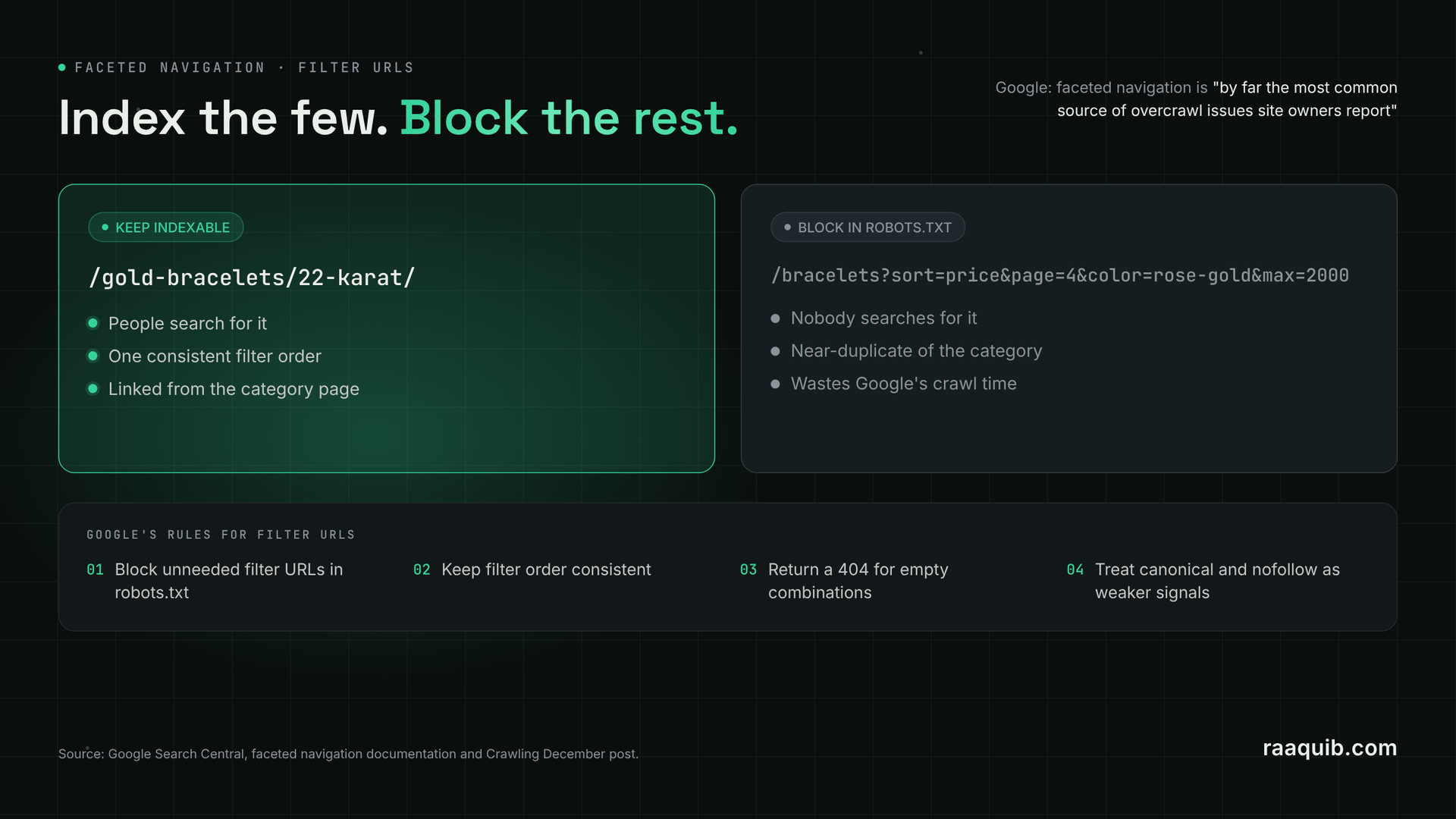
UAE stores should block crawling of filter URLs that nobody searches for, and keep only the filter combinations with real search demand as indexable pages. Faceted navigation is the set of filters for size, color, price and brand. Each combination can create a new URL, and Google warns that this wastes crawling time.
Google's crawling documentation names two problems: overcrawling of filter URLs and slower discovery of new pages. Time spent on near-duplicate filter pages is time not spent finding your new stock.
In a December 2024 Search Central post, Google called faceted navigation “by far the most common source of overcrawl issues site owners report” to Google.
Google's recommended options:
- If you don't need filter URLs indexed, block them in robots.txt, the file that tells crawlers which paths to skip.
- If you need some indexed, keep filter order consistent and avoid duplicate filters.
- Return a 404 status for filter combinations with no products.
- Treat canonical tags and nofollow links on filters as weaker, longer-term signals.
A filter page such as “22 karat gold bracelets” can deserve indexing if people search for it. “Bracelets, sorted by price, page 4, rose gold, under AED 2,000” almost never does. Setting these filter rules is a standard part of my work as a technical SEO consultant in Dubai.
Product page SEO: the data Google and AI assistants read
Product page SEO is the work of making each product page clear to shoppers and machine-readable for Google. For a UAE store, that means unique copy, complete structured data with AED prices that include value-added tax (VAT), and shipping and return terms Google can read.
Structured data is code that labels the facts on a page, such as price and availability. Google's merchant listing documentation says merchant listings require a Product with a nested Offer that includes a price and a currency. Only pages where a shopper can buy the product qualify.
Three rules matter most for UAE stores:
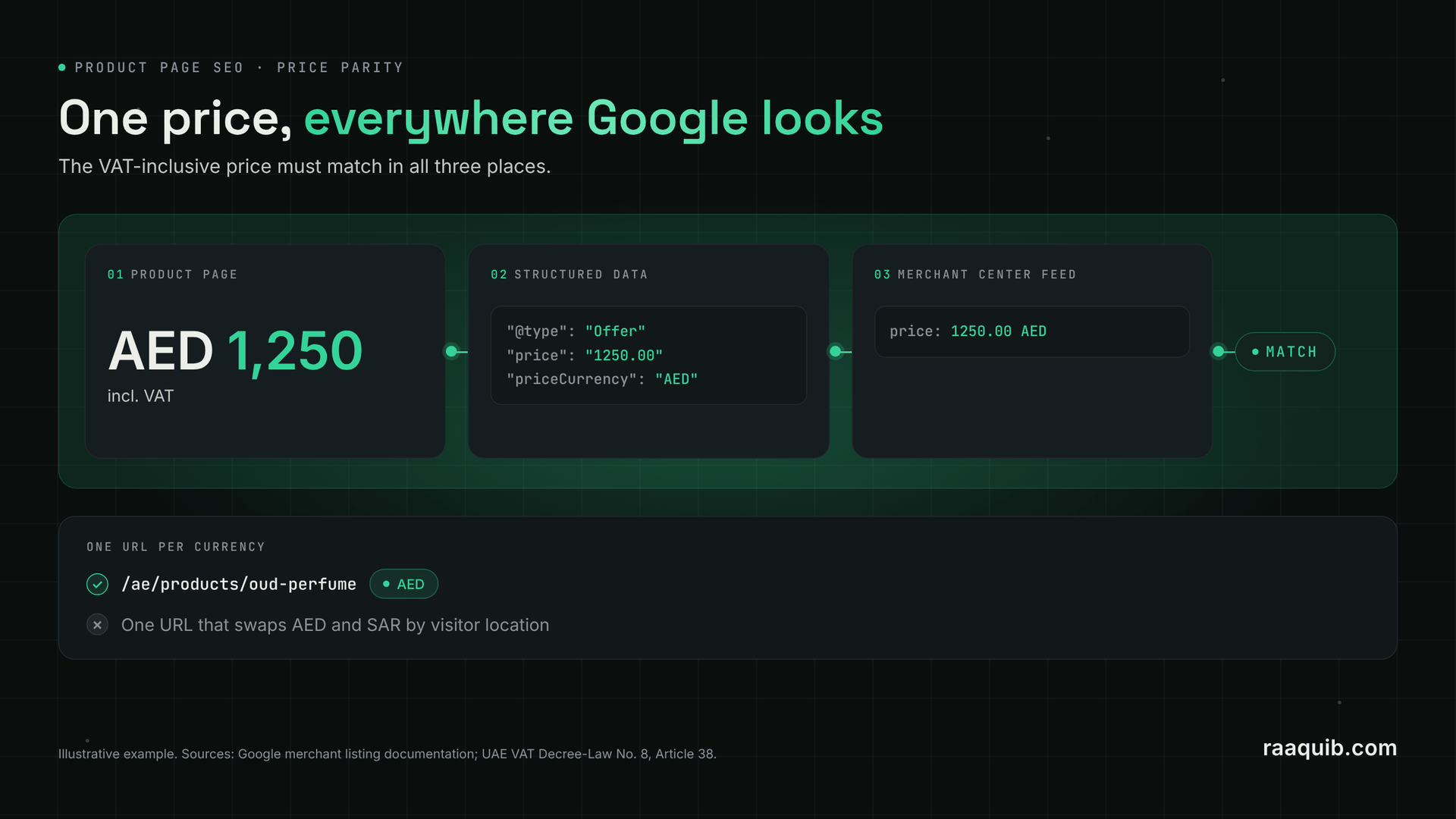
- One URL per currency. Google asks for a distinct URL for each currency. A page that switches between AED and SAR on the same URL breaks that rule. My guide to GCC SEO expansion covers country URLs for Gulf Cooperation Council (GCC) markets.
- Markup in the page code. Put markup in the initial HTML, the raw code your server sends. Google warns that markup generated by JavaScript can make Shopping crawls less frequent and less reliable.
- A real price. Merchant listings need a price greater than zero.
| Do | Don't |
|---|---|
| /ae/products/oud-perfume with priceCurrency AED | One URL that swaps AED and SAR by visitor location |
| Price in copy, markup and feed all identical | A sale price on the page and the old price in markup |
Source: Google Search Central, merchant listing structured data, checked 27 October 2026.
Prices also carry a legal rule in the UAE. Article 38 of Federal Decree-Law No. 8 of 2017 states that for taxable supplies, the advertised price shall include the tax (PDF). Show the VAT-inclusive figure in copy, markup and feed. This is not legal advice; confirm your obligations with your tax adviser.
Return and shipping terms belong in structured data too. Google suggests setting a standard return policy once, using MerchantReturnPolicy nested under Organization, or in Merchant Center or Search Console. Where both exist, Google says it uses the Search Console settings.
Reviews need honesty. Google's review snippet guidelines say not to include fake or undisclosed incentivized reviews on the page or in the markup.
Shopify SEO in the UAE: what the platform does for you and what it doesn't
Shopify SEO in the UAE starts from a reasonable base. Shopify's own themes handle canonical tags, and Shopify Markets generates hreflang tags for language and country versions. Shopify does not write useful category copy, decide which filters to index, or produce Arabic content worth ranking.
On duplicates, Kyle Risley, senior lead for SEO at Shopify, wrote in August 2025: “Shopify themes automatically canonicalize URLs.” He added that Shopify's first-party themes set a canonical URL on all pages. The catch: a third-party or custom theme may not do the same, so check yours before you assume the problem is solved.
For international setups, Shopify's help center says hreflang tags are generated automatically from your market and language configuration, and recommends subfolders for most stores. Hreflang is the annotation that tells Google which language or country version of a page to show. Shopify also excludes search engine crawlers from location-based redirects, so Google can see every version.
The weak point is content. Google ignores hreflang tags unless both pages point to each other, and it detects a page's language from the text, not the tags.
My guide to bilingual SEO for Arabic and English pages covers the setup in detail.
How do AI shopping answers choose which stores to show?
AI shopping answers in Google draw on the same signals as regular search, plus product data. Google says there are no special optimizations needed for AI Overviews or AI Mode. What helps is accurate product information that matches across your page, your structured data and your Merchant Center feed.
Google's documentation on AI features states that there are no additional requirements to appear in AI Overviews or AI Mode, nor special optimizations. Its best practices include structured data that matches the visible text and an up-to-date Merchant Center account.
Google AI Overviews already reach UAE shoppers. As of 27 October 2026, Google's help page lists the United Arab Emirates and Arabic as supported for AI Overviews.
The data behind shopping answers is large. In May 2025, Google said its Shopping Graph held more than 50 billion product listings, with more than 2 billion refreshed every hour. Google announced the new AI Mode shopping features for the US first. Accurate, consistent product data is also the core of Generative Engine Optimization (GEO), the work of getting pages cited inside AI answers.
| What an AI tool told me | What Google's documentation says |
|---|---|
| Add LocalBusiness schema to an online store | Use Product and Offer for merchant listings |
| Write special “AI-optimized” content | No special optimization is needed for AI Overviews or AI Mode |
| No mention of crawl waste from filters | Faceted navigation URLs cause overcrawling |
Left: my first-party test of Claude's unaided answer (no web search) to “how do I do ecommerce SEO in the UAE”, 27 October 2026. Right: Google Search Central, checked the same day.
When should November sale and DSF pages go live?
Sale pages for the November sale season and the Dubai Shopping Festival (DSF) should go live well before the event, on a permanent URL you reuse every year. Google needs time to index a page before demand arrives, and a reused URL keeps last season's links.
Alan Kent of Google's Search Relations team advised in October 2020 that a recurring event should use a recurring URL, not a new URL each time. The same post advises creating the page well before the sale so Googlebot can find it.
Dubai's Department of Economy and Tourism (DET) announced that the 31st DSF would run for 38 days, from 5 December 2025 to 11 January 2026.
| URL pattern | Result |
|---|---|
| /dsf-2026/ | Starts from zero every year |
| /dsf/ | Keeps last year's links, updated each season |
The same logic applies to Ramadan and Eid. My Ramadan SEO timing guide works through the dates for 2027.
What does this look like on a real UAE store?
A Dubai gold and jewelry retailer I worked with had traffic from browsers, not buyers. I rebuilt its search presence around buying-intent pages, published mid- and bottom-of-funnel content that passed internal links to priority landing pages, and earned links from UAE investment sites.
Over six months, organic traffic rose 93%, from 4.7K to over 9.3K visits, with five times the search impressions, verified in Google Search Console. Conversions through forms, WhatsApp and phone calls rose fourfold. The store sold through inquiries rather than a checkout, so I tracked those as conversions. The full Dubai gold business SEO case study shows the data.
A 90-day priority plan for a UAE online store
- Crawl the catalog. List every filter, sort and pagination URL, and every discontinued product.
- Set filter rules. Keep filter pages with search demand, and block the rest in robots.txt.
- Fix product data. Check that price in AED, availability, shipping and returns match across page, markup and Merchant Center.
- Rebuild your top categories. Start with the highest-margin categories and add buying guidance.
- Check your platform. On Shopify, confirm canonical tags and Markets hreflang, and review Arabic copy with a native speaker.
- Publish sale pages early. Put November sale and DSF pages on permanent URLs and link them from the home page.
- Measure by category. Track organic revenue and inquiries per category in Google Analytics 4 and Google Search Console (GSC).
If your categories keep losing to Amazon.ae and noon, the fix usually sits in the store's structure, not its blog. As an ecommerce SEO consultant in Dubai, I start by crawling your catalog. I look for the filter URLs Google is wasting time on and the product data your pages and feed disagree on. Then I rank your categories by margin and search demand and rebuild the most valuable first. You get a plan your developers can build before the next sale season.
Frequently asked questions
Can a small UAE store really compete with Amazon.ae and noon in Google?
Yes, on the right searches. Marketplaces usually win broad product names, but a focused store can rank for category, attribute and delivery searches where shoppers need guidance. Pick the categories you know best and build pages that answer the buying question.
What structured data does a product page need for Google Shopping results?
Google's merchant listing documentation requires Product markup with a nested Offer that includes a price above zero and a currency, such as AED. Add shipping details and a return policy, ideally set once at Organization level, and keep every value identical to what the shopper sees on the page.
Is there special optimization for Google AI Overviews?
No. Google's documentation says there are no additional requirements or special optimizations to appear in AI Overviews or AI Mode. Standard SEO applies, plus structured data that matches the visible page and Merchant Center information that is kept current, which matters most for stores selling products.
Raaquib Pathan
SEO and AI Search Consultant, Dubai
Raaquib Pathan is an SEO and AI search consultant based in Dubai. He has worked in search since 2019 across agency, in-house SaaS and independent consulting, helping brands grow organic traffic and get cited inside AI answers.
Want your brand cited in AI answers?
Book a free strategy call. We look at where you show up across Google and AI search today, and the fastest path to being the source that gets cited.
Ecommerce SEO Consultant in Dubai
Catalog crawls, filter rules and product data fixes for UAE online stores.
Read moreConsultingGCC SEO
Domains, hreflang and duplicate risks when expanding from the UAE to Saudi Arabia and Qatar.
Read moreConsultingRamadan SEO
When UAE Ramadan searches peak, when pages must be live, and what to build.
Read more