
Fintech SEO in the UAE: Ranking in a YMYL Industry
Last updated · 12 min read
Key takeaways
- Google treats money topics as “Your Money or Your Life” (YMYL) content and gives more weight to trust signals on those pages.
- UAE regulators treat the same pages as financial marketing, so every claim on a fintech site has two reviewers: Google and your regulator.
- Named authors, license details and clear risk wording pass compliance review and match what Google looks for.
- In my November 2026 spot check, Google showed no AI Overview for four finance queries, and Perplexity cited secondary sources more than regulators.
Fintech SEO in the UAE is the work of getting licensed financial products found on Google and cited by AI assistants while every page stays inside UAE financial marketing rules. Most guides that rank for fintech SEO UAE cover keywords and links. They skip the part that decides whether a page can rank at all: trust.
Google judges money pages more strictly than most topics, and UAE regulators judge them as marketing. This guide shows where the two reviews overlap and how I build fintech content that passes both. It is SEO guidance, not legal advice.
What is fintech SEO in the UAE, and why does Google treat it as YMYL?
Fintech SEO in the UAE means ranking payment, lending, banking, insurance, investment and crypto pages while Google applies its strictest quality standards to them. Google calls these Your Money or Your Life topics, because bad information can damage a person's financial stability.
Google's own documentation explains the extra weight. For topics that could significantly affect health, financial stability or safety, Google's systems give even more weight to strong E-E-A-T. E-E-A-T stands for experience, expertise, authoritativeness and trust. Google adds that trust is the most important of the four, and that E-E-A-T itself is not a specific ranking factor.
YMYL SEO is the practice of meeting that higher bar. You don't add E-E-A-T like a plugin. You show it through who writes, who checks and how you source.
Google's Search Quality Rater Guidelines, a PDF dated 11 September 2025, define “YMYL Financial Security” as topics that could damage a person's ability to support themselves and their family. The guidelines set very high Page Quality rating standards for clear YMYL pages. Raters don't change rankings directly, but their guidelines describe what Google wants its systems to reward.
Which UAE regulators shape what a fintech page can say?
The regulator that matters depends on your license and your activity. A payments app, a DIFC wealth manager and a Dubai crypto exchange answer to different authorities, and each one treats web content as marketing. Check your license first, because it decides which rulebook your product pages, blog and ads must follow.
| Regulator | Who it covers | What it means for your pages |
|---|---|---|
| Central Bank of the UAE (CBUAE) | Onshore banks, payments, lending, insurance | Consumer protection rules on advertising and disclosure |
| Capital Market Authority (CMA) | Onshore securities, investment products, finfluencers | Rules on financial recommendations and promotion |
| Dubai Financial Services Authority (DFSA) | Firms in the Dubai International Financial Centre (DIFC) | Financial promotion rules for anything made in or from the DIFC |
| Financial Services Regulatory Authority (FSRA) | Firms in Abu Dhabi Global Market (ADGM) | ADGM conduct and promotion rules |
| Virtual Assets Regulatory Authority (VARA) | Virtual assets in or targeting Dubai, outside the DIFC | Marketing regulations, including blogs and social posts |
Source: CBUAE Rulebook, Federal Decree-Law No. 32 of 2025, DFSA, VARA Rulebook.
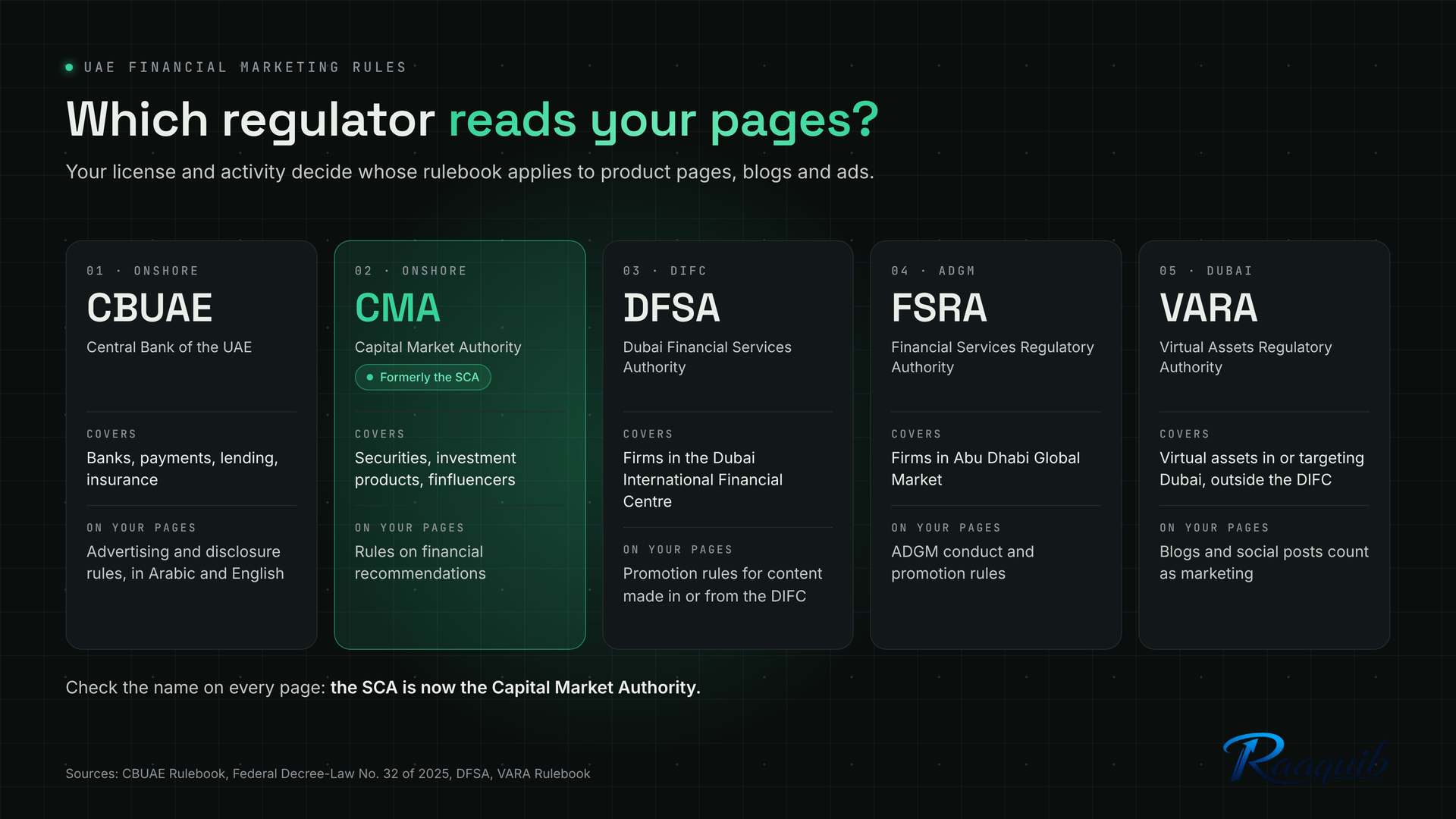
Check the regulator's name on every page. Federal Decree-Law No. 32 of 2025 states that the name “Securities and Commodities Authority” in any legislation is replaced by “Capital Market Authority” (PDF). The law took effect on 1 January 2026.
Some agency pages that rank for this topic still name only the SCA. A careful reader notices outdated details like that.
The DFSA definition shows how wide these rules reach. The DFSA says it is unlawful, with limited exceptions, for an unauthorized person to make a financial promotion in or from the DIFC. It defines a financial promotion as any communication that invites or induces a person to deal in a financial service, written, verbal or digital. A product page with a sign-up button fits.
What does E-E-A-T for finance look like on a fintech website?
E-E-A-T for finance is something a reader can see on the page. It is a named author with real credentials, a reviewer who checked the claims, clear details about the licensed company behind the site, and sources a reader can open. The same elements answer Google and your regulator.
Here is the overlap I use with clients.
| Page element | What Google looks for | What UAE rules ask for |
|---|---|---|
| Named author and reviewer | Accurate bylines, no fabricated profiles | Recommendations by individuals need CMA registration |
| Company and license details | Clear information on who runs the site | Only authorized firms may promote in or from the DIFC |
| Claims and risk wording | An especially high accuracy standard | CBUAE: advertising must not be deceptive or misleading |
| Arabic and English versions | Clear language signals for each page | CBUAE: disclosure information in Arabic and English |
Source: Google Search Central, Google Search Quality Rater Guidelines (11 September 2025), CBUAE Rulebook, DFSA, WAM.
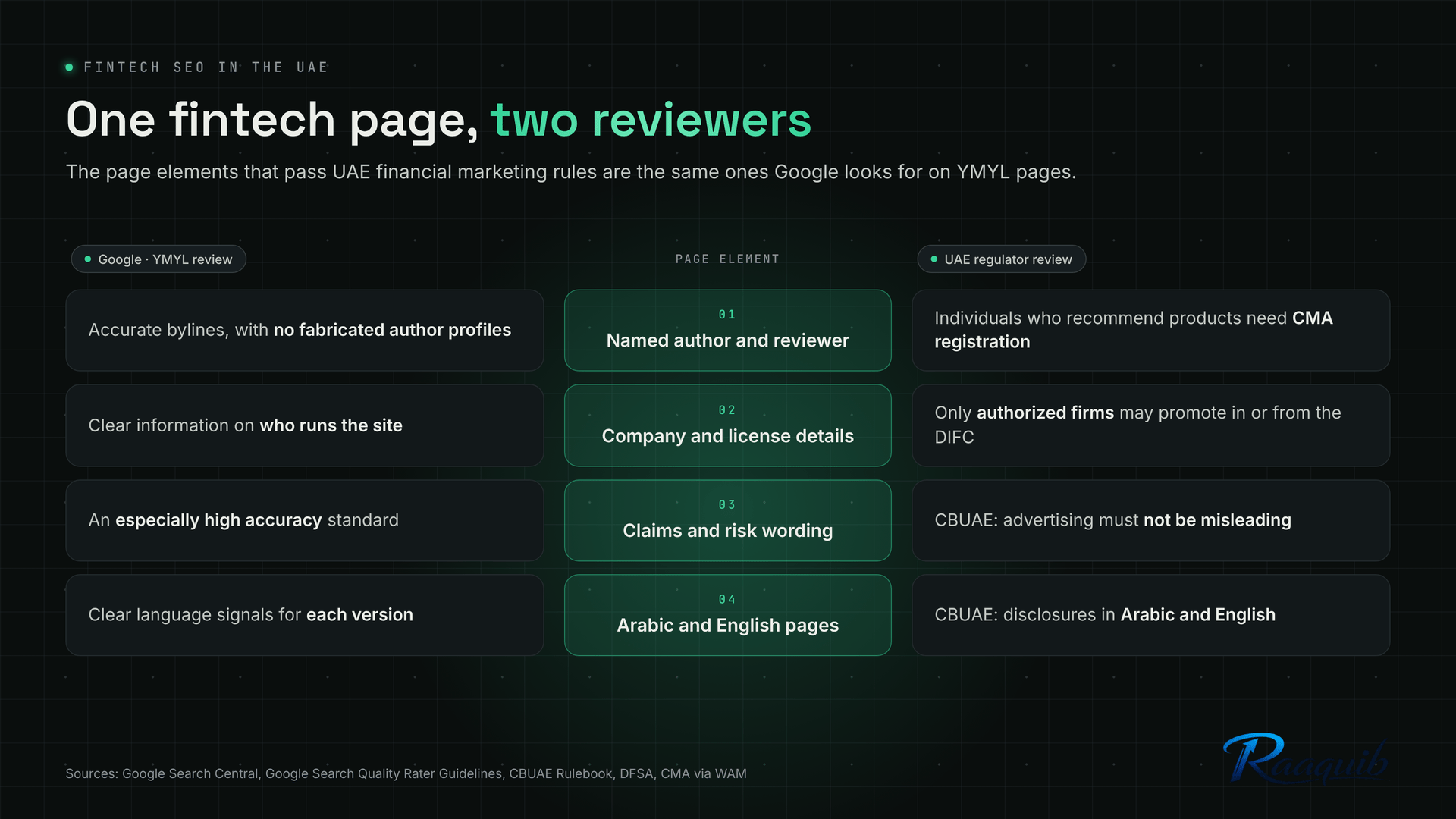
Start with authorship. Google's helpful content guidance encourages accurate bylines and says fabricating creator profiles, such as AI-generated headshots, made-up names or false credentials, is a form of deception.
Next, the company itself. The rater guidelines list a complete lack of information about who is responsible for a website as a reason to rate a YMYL page Lowest. For a fintech, that means an About page with the legal entity name, the licensing authority, the license number and a way to verify it.
Then the numbers. Every rate, fee, return or market figure needs a source and a date. While researching this article, I found a Dubai agency page stating a count of licensed UAE fintech companies with no source at all. That is exactly the accuracy problem the rater guidelines describe.
A fintech page that passes both reviews includes:
- A byline linking to an author page with real credentials
- A “reviewed by” line naming the compliance or subject expert
- The legal entity, regulator and license number on the About page
- A visible “last reviewed” date
- Primary sources for every rate, fee and regulatory claim
Finfluencers, guest posts and links: what changed in 2025 and 2026
Creator content and paid placements are regulated marketing in the UAE. Before you pay for a sponsored post, a video review or a guest article, check who may publish it and what it must disclose.
The UAE Securities and Commodities Authority (SCA) launched a “Finfluencer” license for individuals offering financial or investment recommendations through digital or traditional media on 28 May 2025. That regime now sits with the CMA.
In an April 2026 statement reporting 171 authorized finfluencers with more than 24.6 million followers, CMA chief executive Waleed Saeed Al Awadhi said financial content “can directly influence investment decisions.”
Crypto marketing has its own rulebook, and as a crypto SEO consultant in Dubai I treat it as the brief for every page. VARA's Marketing Regulations apply to all entities, licensed or not, and they list social media posts, blogs and endorsements as marketing.
Under VARA's rules, paid third-party content needs a clear and prominent notice. Virtual asset marketing must also carry a prominent risk disclaimer about losing value and extreme volatility. The catch for link building is that VARA does not treat key opinion leaders as journalists or educators, so their posts get no exemption.
My checklist before any creator or guest-post partnership:
- Confirm CMA registration if the content recommends a product
- Label paid placements on the page and in the link attributes
- Put the required risk wording in the brief
- Get compliance approval before publication
- Prefer relevant UAE financial sites over link volume
Relevant local links are where I have seen results. For a Dubai gold and jewelry retailer, part of the trust work was earning mentions from UAE investment-related websites. Between February and July 2025, organic traffic grew 93%, from 4,700 to more than 9,300 visits, as shown in my gold and jewelry SEO case study.
Why Arabic and English pages matter for financial services SEO
For licensed financial institutions, Arabic is a compliance requirement as well as a search opportunity, and that changes how you plan financial services SEO in the UAE. My research on UAE search behavior covers who searches in Arabic and who searches in English.
The Central Bank of the UAE (CBUAE) Consumer Protection Standards state that all disclosure information must be available in Arabic and English. The CBUAE rulebook also says advertising must not be deceptive, misleading, fraudulent or unfair. If your fee disclosures exist in Arabic, those pages deserve the same SEO care as the English versions: their own URLs, matching content and correct language signals.
Plan both languages together. My guide to bilingual SEO in the UAE covers hreflang, the markup that tells Google which language version to show, and the URL structures that work.
How do AI Overviews and Perplexity answer UAE finance questions?
Google's help page lists the UAE and Arabic as supported for AI Overviews. Yet in my November 2026 spot check, Google AI Overviews did not appear for any of four finance queries. Perplexity did answer, but it cited Google documentation and agency pages more often than UAE regulators. On those queries, classic organic results carried the whole page.
AI adoption in the UAE is high. Microsoft's AI Diffusion Report (PDF), based on Microsoft's own usage telemetry, puts UAE generative AI use at 70.1% in Q1 2026. That figure covers the working-age population and was the highest in the world.
On 2 November 2026, I ran four finance queries through Google with UAE settings and two prompts through Perplexity. This is a first-party spot check with a small sample, so treat it as a snapshot. For wider UAE data, see my SEO stats in the UAE.
| Surface and query | AI answer shown? | What the answer cited |
|---|---|---|
| Google: “fintech SEO UAE” | No AI Overview | Nine organic results, mostly agency pages |
| Google: “how do fintech companies in the UAE rank on Google YMYL” | No AI Overview | Organic results only |
| Google: “does google treat finance websites differently YMYL” | No AI Overview | Organic results only |
| Google: “what is E-E-A-T for finance websites” | “An AI Overview is not available for this search” | Organic results only |
| Perplexity: “How should a UAE fintech do SEO given YMYL and E-E-A-T?” | Yes | Google documentation and an agency page |
| Perplexity: “Which UAE regulators control what a fintech can publish?” | Yes | VARA rulebook, UAE government portal, law and agency pages |
Source: first-party test by Raaquib Pathan, 2 November 2026, Google Search (UAE, English) and Perplexity.
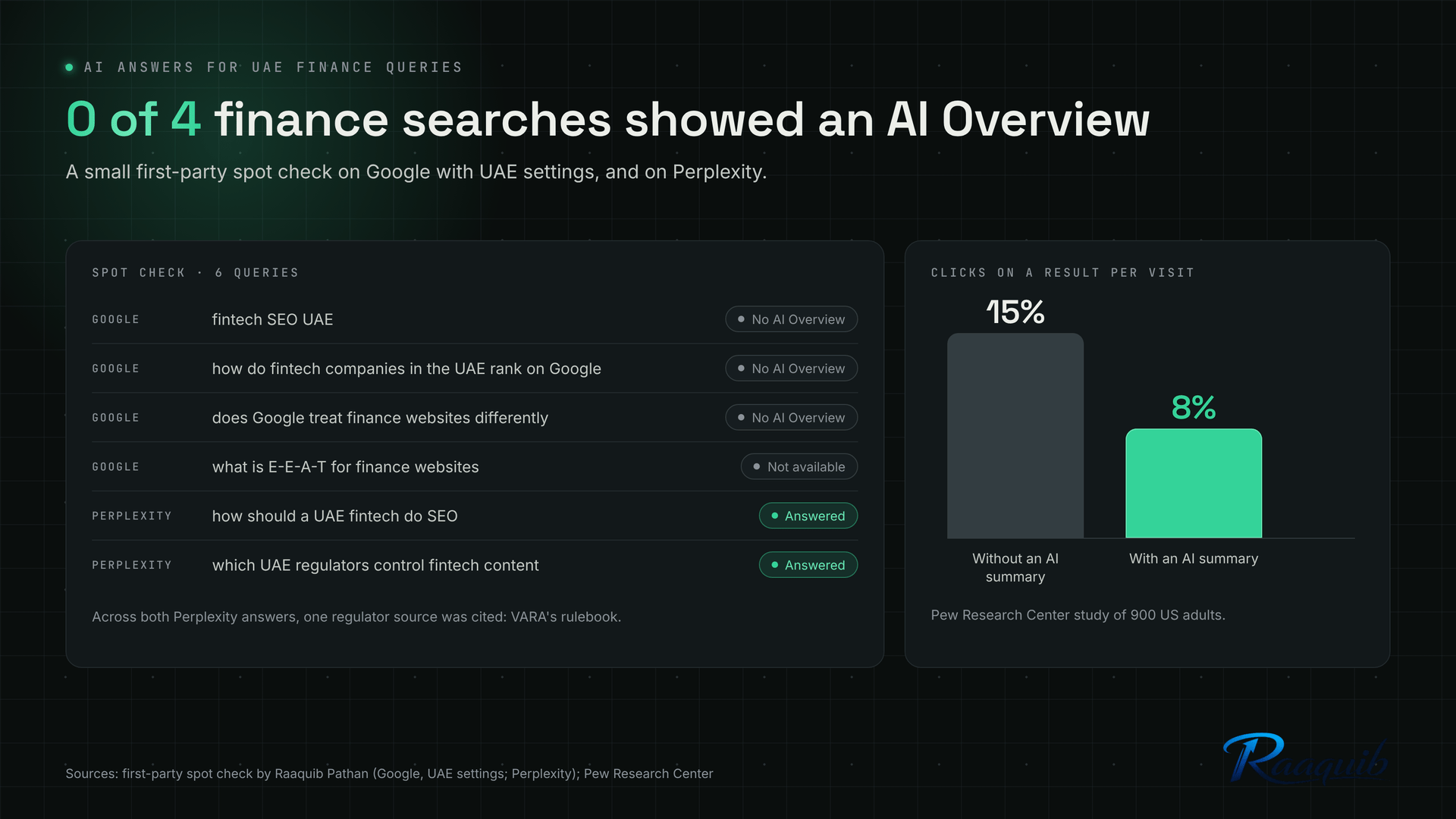
In my test, VARA's rulebook was the only regulator source either Perplexity answer cited, and neither answer mentioned the CBUAE Arabic disclosure rule. That gap is an opening for fintechs that publish primary-sourced pages.
Answer Engine Optimization (AEO) and Generative Engine Optimization (GEO) are the names for optimizing to appear in these answers. If you are new to the terms, start with my explainer on Generative Engine Optimization. Google says its generative AI features are “rooted in our core Search ranking and quality systems”. Google's guide adds that you don't need new AI text files or special markup to appear.
Clicks change when a summary appears. A Pew Research Center study of 900 US adults found that, in March 2025, users clicked a result in 8% of visits with AI summaries, against 15% without one. Track AI visibility directly. Since 31 August 2026, the Search Console Generative AI performance report has been available to all websites.
Schema and technical trust signals for UAE fintech sites
Structured data helps Google understand who you are, but it does not earn trust on its own. Use it to describe facts that are already visible on the page.
For a licensed company, Schema.org's FinancialService type includes a property for fees and commissions, with subtypes such as BankOrCreditUnion and InsuranceAgency. Pair it with Organization markup for the legal entity and Person markup for each author and reviewer.
Google's AI guide says structured data isn't required for generative AI search. I still add it for rich results and consistent entity details. I never mark up a credential, rating or fee the page doesn't show. I compare what changes and what doesn't in SEO vs GEO.
A YMYL publishing workflow for UAE fintech teams
A fintech content workflow puts compliance review inside the process, not at the end. This is the order I use.
- Map each page to its regulator and license before drafting.
- Draft from real customer questions and primary sources only.
- Add the byline, the reviewer and the last-reviewed date.
- Fact-check every figure, title tag, meta description and alt text.
- Send the page to compliance with sources attached.
- Publish the Arabic and English versions together where disclosure applies.
- Recheck the page when a fee, rate, rule or regulator name changes.
Step 4 now has Google behind it. Google's guidance on generative AI content, updated on 1 October 2026, says it is critical to manually fact-check AI-generated content before publishing. The review covers titles, meta descriptions, structured data and image alt text too. Mass-producing city or product pages carries its own risk, because Google's spam policies define scaled content abuse as many pages generated mainly to manipulate rankings.
The closest proof I can show for YMYL work is in health, which Google judges the same way. For a mental wellness platform starting on a new domain, certified specialists wrote the content while I handled keyword research and on-page work. Monthly organic traffic grew from zero to more than 10,000, with over 150 monthly sign-ups, as documented in my healthcare SaaS SEO case study.
I work with UAE banks, payment companies, lenders, insurers and trading platforms that need search growth without extra work for compliance. I map each product to its regulator, build bylines that match real credentials, and plan Arabic and English pages together. If that is your problem, see how I work as a finance and fintech SEO consultant in Dubai.
Frequently asked questions
Is fintech content YMYL in Google's eyes?
Yes. Google describes topics that could significantly affect a person's financial stability as Your Money or Your Life topics. Google's systems give more weight to strong E-E-A-T there. Google's rater guidelines apply very high quality standards and an especially high accuracy standard to those pages.
Do UAE financial marketing rules apply to blog posts?
Often, yes. VARA lists blogs and social posts as marketing for virtual assets, and the DFSA defines a financial promotion as any communication that invites or induces someone to deal. Treat educational posts with product calls to action as marketing, and confirm your obligations with your regulator.
Do UAE fintechs need Arabic pages for SEO?
If you are a CBUAE-licensed institution, the Consumer Protection Standards require disclosure information in Arabic and English. That makes Arabic pages a compliance task first. Build them as full pages with their own URLs and language signals, so Google can rank each version for the right searcher.
Do AI Overviews appear for finance searches in the UAE?
Google lists the UAE and Arabic as supported for AI Overviews. In my spot check on 2 November 2026, none of four finance queries returned one, and one showed that an AI Overview was not available. Track your own queries in Search Console's Generative AI performance report.
Raaquib Pathan
SEO and AI Search Consultant, Dubai
Raaquib Pathan is an SEO and AI search consultant based in Dubai. He has worked in search since 2019 across agency, in-house SaaS and independent consulting, helping brands grow organic traffic and get cited inside AI answers.
Want your brand cited in AI answers?
Book a free strategy call. We look at where you show up across Google and AI search today, and the fastest path to being the source that gets cited.
Finance & Fintech SEO Consultant in Dubai
Search growth for UAE banks, payments, lenders and trading platforms, inside regulator rules.
Read moreConsultingBilingual SEO in the UAE
How Google reads Arabic and English pages, hreflang, and the URL structure to pick.
Read moreAI SearchSEO Stats in UAE
79 verified SEO and AI search statistics for the UAE in 2026.
Read more